Carpet and padding are sponges. Once water soaks through, the pad underneath holds moisture long after the surface feels dry, and mold can start in the pad, the backing or the tack strip. Whether carpet can be saved depends on the water source and how fast it is dried.
This guide covers the decision, the timeline and the signs of mold in carpet.
The 24 to 48 hour window
Public health guidance for flooded buildings points to a drying window of about 24 to 48 hours before mold becomes likely. That figure comes from guidance written for public buildings, and a home carpet is no different in principle. The faster it dries, the better the odds.
If the carpet has been wet longer than that, assume growth may have started under the surface and check the pad and the subfloor.
Save it or replace it?
| Water source | Carpet | Pad |
|---|---|---|
| Clean water, caught within a day or two | Often dried in place or lifted and dried | Usually replaced, since it is cheap and holds moisture |
| Clean water, wet for several days | Judged by smell and moisture readings | Replace |
| Gray water from a washer or dishwasher | Often replaced | Replace |
| Sewage or flood water | Remove and discard | Remove and discard |
Pad is the part most people do not think about. It is inexpensive to replace and almost impossible to dry fully under a stretched carpet, so most crews pull and replace it.
Signs of mold in wet carpet
- A musty or earthy smell that comes back after cleaning.
- Dark or fuzzy spots on the underside of the carpet or on the pad.
- Staining on baseboards or the bottom of drywall nearby.
- Allergy-like symptoms that ease when you leave the room. We cannot diagnose them, so ask a physician about health concerns.
Wet carpet that will not dry or smells musty?
How a crew dries carpet
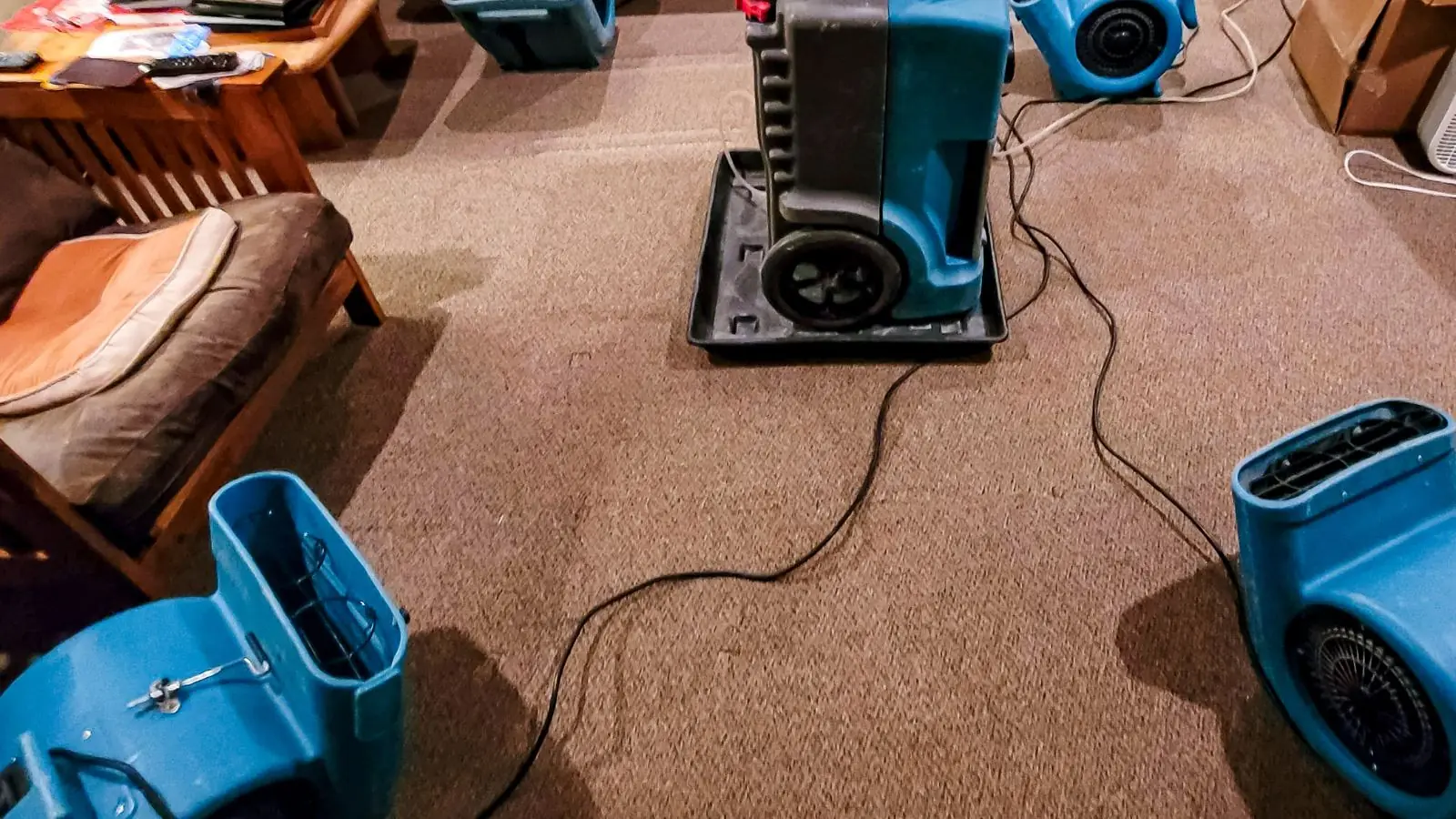
The crew extracts standing water, lifts the carpet at a corner, removes the pad, and sets air movers and a dehumidifier to dry the carpet and the subfloor. Moisture readings on the subfloor show when it is dry. The process sits under our water mitigation service, and the stage before drying is the emergency water removal step.
If mold is already present on the subfloor or tack strip, the mold remediation page explains the containment and removal steps.
What not to do
- Do not run a household fan alone and hope. Without dehumidification the moisture moves into the walls.
- Do not use a shop vacuum on sewage water.
- Do not cover wet carpet with furniture or plastic.
- Do not wait to see whether the smell goes away.
Homeowners in Shrewsbury and Hopkinton deal with the same problem, and finished basements with carpet are a common case.
Taking carpet out safely
- Wear an N-95 respirator, gloves and goggles.
- Cut the carpet into manageable strips so it is not dragged through the house.
- Bag the carpet and pad in heavy plastic before carrying it out.
- Vacuum the subfloor with a HEPA vacuum and wipe it with detergent and water.
- Dry the subfloor fully and take a moisture reading before new flooring.
Carrying wet moldy carpet through clean rooms spreads spores. Plastic and a short path to the door make a real difference.
Choosing new flooring
Where water is a recurring risk, as in a basement, carpet is a questionable choice. Tile, vinyl plank or sealed concrete handle water better, and they can be dried quickly. If you do put carpet back, use a pad rated for damp conditions and keep humidity in check.
Rebuilding the floor falls under water damage repair. Households in Northborough and Grafton have the same choices.
Allergens, smell and what they tell you
A musty smell from carpet is a hint, not a diagnosis. It can come from old dampness in the pad even when the surface looks clean. If a smell stays after a thorough cleaning and the carpet has been wet before, assume the pad or subfloor is involved.
We cannot say whether mold in a home is causing a health issue. If someone has symptoms, a physician is the right person to ask, and keeping them out of the work area is sensible.
Deciding about stairs and tack strips
Stair carpet and tack strips along walls can hold moisture and are easy to miss. If a flood reached the stairs or a wall base, pull a corner and check. Wood tack strips that stayed wet often need replacing.
Local note: storm years in the town plan
Westborough's Hazard Mitigation Plan lists the storms that have affected the town, including Tropical Storm Irene in 2011 and Superstorm Sandy in 2012. Carpet in basements and ground-floor rooms is the first thing to suffer when storm water finds its way in.
The plan reports no repetitive-loss properties in town, so most homes have not flooded repeatedly. A single event is still enough to ruin carpet if it is not dried quickly.
Source type: Westborough Hazard Mitigation Plan and public health drying guidance.
Questions homeowners ask
Sometimes, if the water was clean and the carpet is dried within a day or two. The pad is usually replaced.
Lift a corner and look at the underside, the pad and the tack strip. A musty smell is a clue. A crew can confirm with moisture readings.
Often when the cause was sudden and accidental, such as a burst pipe. Flood and groundwater are usually excluded. Ask your insurer.
Basement flooding is a common reason for calls in the region. Sump pumps, grading and storms are the usual causes.