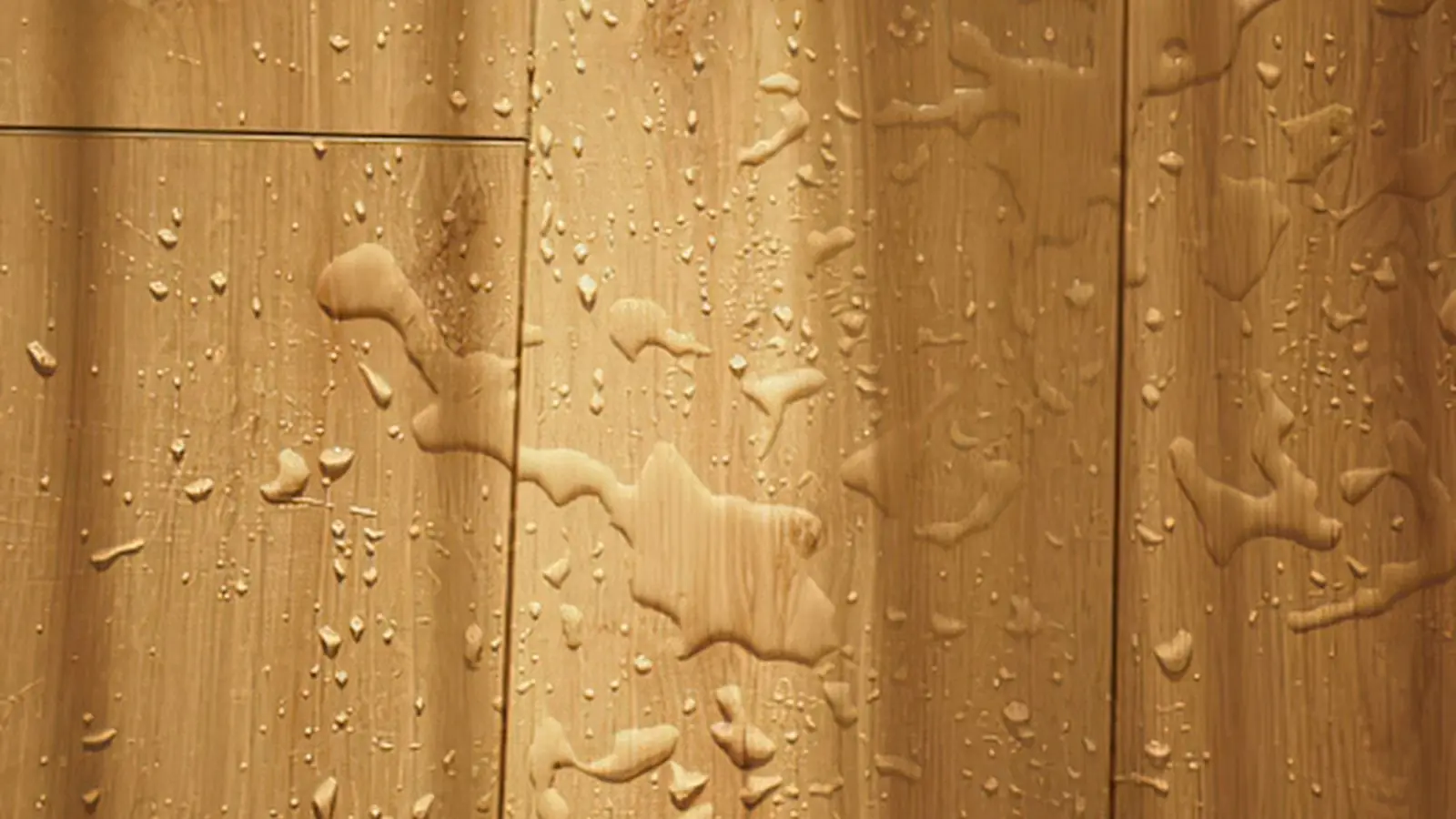
Laminate looks tough, and it handles spills well, but it handles standing water poorly. The core of most laminate planks is wood fiber board. When water reaches it, it swells, and the planks do not shrink back. Whether a laminate floor can be saved depends on how much water, for how long, and where it went.
This guide explains what happens under the surface and how to decide between drying and replacing.
What laminate is made of
A laminate plank has a printed decorative layer, a clear wear layer on top, a fiberboard core and a backing layer. The top is water-resistant. The core is not, and the seams between planks are where water gets in.
Most laminate floats over underlayment on the subfloor, without glue. That makes it easy to take up and dry, but it also means water can travel under the whole floor and spread beyond the visible spot.
Spill, leak or flood: three different outcomes
| Event | What happens | Usual outcome |
|---|---|---|
| Spill wiped within minutes | Water does not reach the core | Usually no damage |
| Slow leak from a dishwasher, fridge line or pipe | Water wicks into seams, edges swell, underlayment stays wet | Planks near the source replaced, subfloor dried |
| Standing water for hours | Core swells across the room | Often replaced, subfloor checked |
| Flood or sewage water | Contaminated core and underlayment | Remove and replace |
Signs the floor is past saving
- Edges that peak or curl at the seams.
- Planks that feel spongy, or a floor that has lifted or buckled.
- Water stains or mold on the underside of planks you lift.
- A musty smell that returns after cleaning.
- Visible gaps where planks have swollen and then dried.
Wet laminate and not sure how far the water went?
How drying works
The crew lifts a few planks to see what is below, then measures the underlayment and subfloor. If the water is clean and the event was recent, planks can sometimes be taken up, dried and relaid. In most cases the swollen planks are replaced, while the underlayment is discarded and the subfloor is dried with air movers and a dehumidifier.
Water under the floor is the hidden part of the job, and it is why our water mitigation work focuses on readings, not appearances.
Checking the subfloor
Plywood and OSB subfloors take water too. OSB swells at the edges, and plywood can delaminate. Concrete slabs hold moisture and release it slowly, which can cause mold under the new floor. A moisture reading before new laminate goes down avoids repeating the damage.
If the subfloor is wet or damaged, the rebuild falls under water damage repair.
What changes the price
- How many rooms of flooring are affected.
- Whether the subfloor needs replacement.
- Drying time and equipment.
- The cost of matching the existing laminate, since patterns and lots change.
Homeowners in Hopkinton and Northborough often ask whether a patch repair is possible. Sometimes it is, but a color match depends on what is still sold.
If you want to try saving the floor
- Remove standing water right away and take up furniture and rugs.
- Pull baseboard trim carefully so the floor can breathe at the edges.
- Lift a few planks near the wettest spot and look at the underside and the underlayment.
- Run fans and a dehumidifier, and keep the room closed.
- Recheck seams after a few days. If edges are rising, plan on replacement.
The click-lock design of many laminates lets you take planks up and put them back. That is helpful if only a few boards were wet. It does not help if the whole room soaked.
Matching new planks
Laminate lines change, and a plank bought years ago may not be available. If matching is not possible, a transition point or a full room replacement may look better than a patch. Keep a few leftover planks from the original install if you can, since they save a lot of trouble.
The drying and moisture readings sit under water mitigation. For floors that were wet from sewage or flood water, see flood damage restoration. Homes in Southborough and Grafton share the same options.
Floating floors and hidden spread
Because laminate floats on underlayment, water travels under the planks to places you cannot see. A small spill by the dishwasher can leave the underlayment wet three feet away. That is why lifting a plank or two to check is better than guessing from the surface.
Rooms with a vapor barrier under the floor may trap water, which then has nowhere to go. Moisture readings from the subfloor tell you when the barrier can be closed up again.
What to keep for your records
- Photos of the swelling, with a ruler for scale.
- The product name or box label for the laminate.
- Receipts for fans or rental equipment.
- Notes on when you first noticed the damage.
Local note: snowmelt and wet boots
Worcester Regional Airport, the nearest long-term weather station, averages about 73 inches of snow a year in NOAA's 1991 to 2020 data. A winter like that means wet boots, slush and snowmelt tracked across entries, mudrooms and kitchens for months.
Laminate near entry doors and under dripping umbrellas is exposed to repeated small wetting, which is different from a one-time flood. If seams at an entry have started to lift, the fix is to dry the area and replace the planks, then add a mat and a tray.
Source type: NOAA climate normals for the Worcester station.
Questions homeowners ask
Sometimes, if the water was clean and the event was recent. Planks that have swollen at the core are normally replaced.
The top is water-resistant, but the seams and the core are not. Products described as waterproof still depend on their seams and the subfloor.
Until moisture readings are in the normal range for the material, which a meter shows. It often takes days, not hours.
Entries see repeated wetting. Mats, trays and quick drying help, and any lifting at the seams is a sign to check underneath.