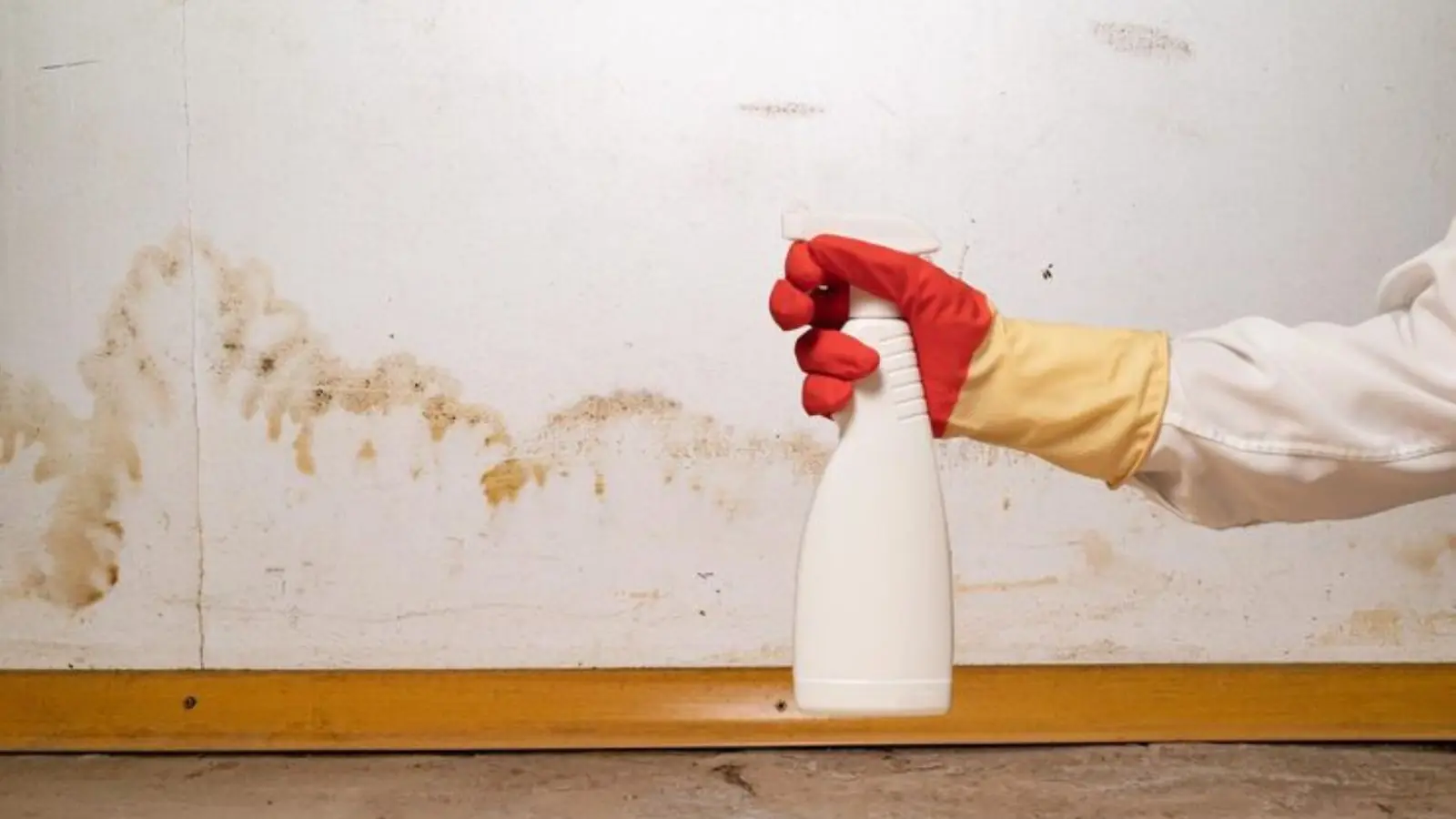
How do you kill mold in a basement? The EPA's answer is that killing it is not enough. Mold has to be removed, because dead mold can still stay on the surface. The practical question is what removes it from the surfaces in your basement and what keeps it off.
This post focuses on the products and methods people ask about most, and where each one works or fails.
Detergent and water does most of the work
For hard surfaces like sealed concrete, tile, metal and glass, scrub with detergent and water, rinse and dry. The EPA says biocides are not recommended as a routine part of mold cleanup. A bucket, a stiff brush and a fan are more useful than a chemical.
Protect yourself with an N-95, long-cuffed gloves and sealed goggles. Work in small sections, and bag the cloths when you are done.
Where bleach, vinegar and borax stand
| Product | What it does well | Where it falls short |
|---|---|---|
| Detergent and water | Lifts mold and residue from hard surfaces | Does not penetrate porous materials |
| Chlorine bleach | Whitens stains on nonporous surfaces | Does not reach roots in wood or drywall, never mix with ammonia |
| White vinegar | Mild cleaning on small areas | Slow, strong smell, no help on porous materials |
| Borax solution | Used by some on wood before sealing | Residue stays, not a substitute for removal |
| Fogging or sprays | Marketing appeal | Do not fix moisture or remove growth |
The EPA warns against mixing chlorine bleach with other cleaners or with ammonia. If you use any disinfectant, ventilate the space and wear chemical-resistant gloves.
Porous materials: remove, do not treat
Drywall, insulation, carpet, paneling and cardboard hold mold below the surface. Spraying them is a patch. The EPA says porous materials may need to be thrown away if they become moldy. If the wall behind a finished basement is wet, the fix is to open it, dry it and replace it.
Mold on drywall, carpet or more than about 10 square feet?
The real fix: control humidity
Mold needs moisture, and basements make a lot of it. Keep indoor humidity below 60 percent, ideally between 30 and 50 percent, the range the EPA recommends. A humidity meter shows the number, and a dehumidifier with a drain hose keeps it there.
Cold basement walls make the problem worse. When warm, humid air meets a cold surface, water condenses on it. Insulating cold pipes, sealing rim joists and running a dehumidifier in summer address the cause.
When to bring in a crew
If the mold returns after cleaning, if it is on wood framing or insulation, or if water came in from outside, a crew with containment is the right answer. See the mold remediation page for how that works, and the flood damage restoration page if the basement took groundwater.
People in Southborough and Grafton ask the same thing, and the answer does not change with the town.
Why killing it is not the goal
The EPA guidance for homeowners says the aim is to remove mold and fix the moisture, not to kill it. Dead mold can still cause reactions, and a surface treatment does nothing for growth inside porous material. A product that promises to kill mold is selling you the wrong outcome.
On hard surfaces, scrubbing with detergent and water physically removes the growth. On porous surfaces, removal usually means cutting the material out.
Common basement surfaces
| Surface | Approach | Caution |
|---|---|---|
| Poured concrete or block | Scrub, rinse, dry | Seepage will bring it back |
| Painted drywall | Often replaced if moldy | Paper facing feeds growth |
| Wood framing and joists | Scrub or sand lightly, dry | Check for rot |
| Stored boxes, fabric, paper | Usually discard | Cleaning rarely saves them |
| Carpet and pad | Remove if wet for days | Pad holds moisture |
If the basement stays damp, no cleaner will hold. Dehumidify, fix the grade and gutters, and test the sump pump. The mold remediation process page explains when a basement job moves beyond homeowner cleaning, and the mitigation service is the drying part.
Households in Northborough and Hopkinton see the same limits on cleaning products.
A realistic expectation
A cleaned basement should look and smell clean within a day or two of drying. It should stay that way. If the smell returns or spots appear again within a month, treat that as a signal about the moisture, not a failure of the cleaner you picked.
Local note: Westborough weather and cold basement walls
The nearest long-term weather record, NOAA's 1991 to 2020 normals for Worcester Regional Airport, shows about 48 inches of precipitation and 73 inches of snow a year. It also counts roughly 130 days with lows at or below freezing and about 45 days when the high stays there too.
Westborough is not Worcester, so treat those as regional numbers. They explain why foundation walls stay cold for months and why summer humidity condenses on them, which is a common cause of basement mold in New England houses.
Source type: NOAA National Centers for Environmental Information, 1991 to 2020 U.S. Climate Normals.
Questions homeowners ask
It cleans small areas, but it is slow and does not help with porous materials. The EPA says removal matters more than killing.
Use it only on nonporous surfaces, with ventilation and gloves, and never mix it with ammonia or other cleaners. It does not reach mold inside drywall or wood.
Because the moisture is still there. Fix the water source, run a dehumidifier and keep humidity in the 30 to 50 percent range.
Finished walls and carpet hold moisture against cold concrete. Whether mold forms depends on moisture control, not on the town.